
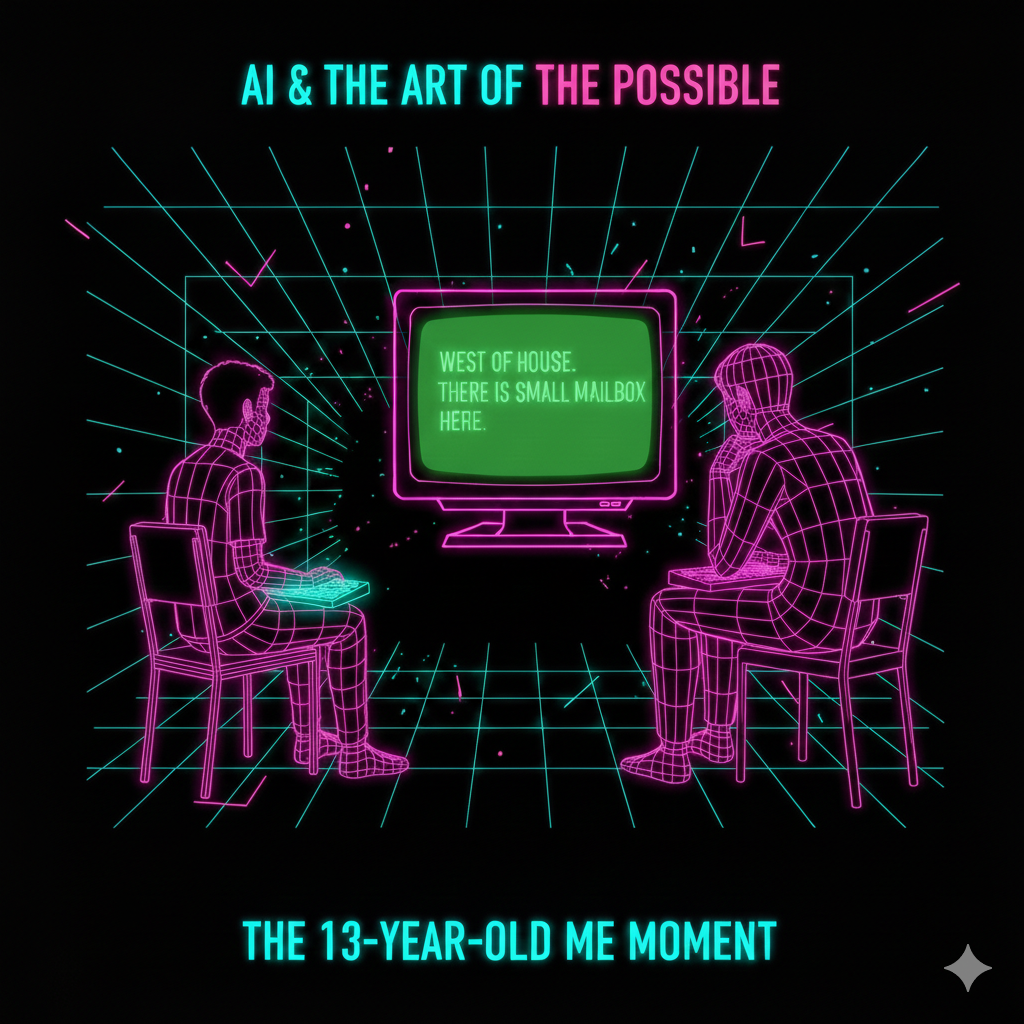
A 1981 text adventure scolds two kids for swearing, then threatens them with a Grue in the dark. Decades later, modern AI tries to recreate that same Zork “magic” and keeps forgetting what it’s doing.
What does Zork reveal about the gap between generating text and actually understanding context and what’s still uniquely human about imagination?
AI & The Art of the Possible — Learning About AI Through Stories, Not Specs
Hosted by Chance Sassano
In this episode, you’ll learn:
- (00:00:00) – The Magic of Zork: A 13-Year-Old’s First Encounter with AI
- (00:01:02) – When a Computer Has Personality and Standards
- (00:02:06) – The Modern AI Challenge: Can ChatGPT Play Zork?
- (00:02:40) – Why Today’s Powerful AI Models Struggle with a 1980s Text Game
- (00:03:26) – The Human Element: Why the Magic Was in Our Heads, Not the Code
- (00:03:50) – Intelligence vs. Pattern Matching: What AI is Still Missing
Key Terms & References:
Claude: A family of large language models developed by Anthropic.
Grue: A fictional, predatory monster from the Zork series that dwells in darkness.
ZorkGPT: A specialized AI model mentioned in the episode that was trained specifically to play the game Zork. Watch a LLM play Zork in real time.
Zork: A pioneering interactive fiction computer game from the late 1970s. You can play it online here.
ChatGPT: An AI chatbot developed by OpenAI.
Episode 10 – The 13 Year-Old Me Moment Full Transcript
Picture this 1985, me, 13 years old taring at a green monitor, and there it is
“West of house.
You are standing in an open field west of a white house with a boarded front door.
There is a small mailbox here.”
Zork, just text on a screen, but in that moment, it felt like magic, like the computer was thinking, like I was talking to something that understood me.
This is AI & the Art of the Possible and today, I’m 13-year-old Chance
EP 10: The 13-Year-Old Me Moment
I’m Chance Sasano, and this is the Art of the Possible, where I reveal which AI breakthroughs are changing everything, and which ones we’re getting wrong.I played Zork with my buddy.
We’d take turns typing commands, laughing at the ridiculous deaths, trying stupid things just to see what would happen.
And that game, it had personality.
One time, we got frustrated and typed something we probably shouldn’t have.
The game responded, “Such language in a high-class establishment like this!”
In 1985, a computer scolded us for cursing. That thing had standards.
But here’s what made it magic. The game understood context. It remembered what you’d done.
If you picked up a brass lantern three rooms ago, it knew.
If you walked into a dark room without it, “It is pitch black. You are likely to be eaten by a Grue.”
That sentence requires you to understand danger, darkness, and that a Grue is something to fear, even though Grues don’t exist.
There’s something profound here. These old text adventures, they’re deceptively complex.
EVERY WORD MATTERS
The game created a world that only existed in words, and somehow, we lived in it.
So last month, I got curious. We’re living in the age of AI right now. ChatGPT writes novels. Claude code creates entire applications. AI can do remarkable things. So obviously, obviously, modern AI could recreate that Zork magic, right?
Okay, so confession time. I haven’t tried it yet myself, not yet. But I went down a rabbit hole. I watched videos online, read online comments, dozens of people trying to get AI to play Zork.
And here’s what I found. It struggles.
The free AI models can’t keep track of where they are. They repeat actions, walk into walls over and over.
The paid AI models, they do better, but even they lose the thread, forget what they’re carrying, make decisions that don’t make sense if you’ve been paying attention.
So one person built something called Zork GPT, an AI specifically trained on Zork, just Zork, and that one works.
Because it’s holding one tiny world in its head, not trying to know everything.
But here’s the thing, part of me really wants to do this. Part of me is curious to see if a modern AI can recreate what I felt at 13. But part of me already knows what I’ll find.
It won’t be the same.
Not because the technology isn’t impressive, it is, but because what made Zork magical wasn’t the game.
It was what happened in my head, the imagination, the world I built from 15 words around a white house and a mailbox.
That 13-year-old staring at the green screen, he had something the machines are still trying to figure out.
Intelligence isn’t just about processing power or pattern matching, it’s about context, memory, the ability to imagine a world that only exist in words and hold it.
AI can generate text. It can predict the next word with stunning accuracy. But it can’t understand that picking up a lantern in one room matters three rooms later.
Can it feel the danger of a Grue? Maybe someday.
Maybe that’s The Art of the Possible but right now, that’s still US.
So I’m holding onto that memory a little longer, that green screen, that feeling of magic, the game that understood me better than most people did.
And when I finally do sit down and try to recreate it with AI, I’ll let you know what I find.
This is AI & the Art of the Possible, I’m Chance Sasano.
If you wanna try Zork yourself, with or without AI, check out the show notes.
Or find our YouTube channel at @AI-TheArtofthePossible
Next episode, researchers ran a test, radiologist versus AI. The results? Unexpected.
The Second Opinion Moment, on AI & the Art of the Possible
