A student writes the perfect essay. An AI checker flags it as fake.
Now they have to write worse to prove they’re human.
Welcome to Tuesday, where the exact same AI builds and destroys.
AI & The Art of the Possible — Learning About AI Through Stories, Not Specs
Hosted by Chance Sassano
Episode 4 – The Double Edge Sword Moment Full Transcript
My friend called me last week, panicked.
Their kid, a straight A student, does everything right. They wrote their college application essay. The teacher ran it through an AI checker.
It came back 100% AI generated.
The kid wrote every single word.
And I actually heard myself tell them, “Make some mistakes. Don’t be too perfect. Write worse.”
We built AI to write better. We built checkers to catch AI writing. Now honest kids have to write worse to prove they’re human.
Welcome to Tuesday
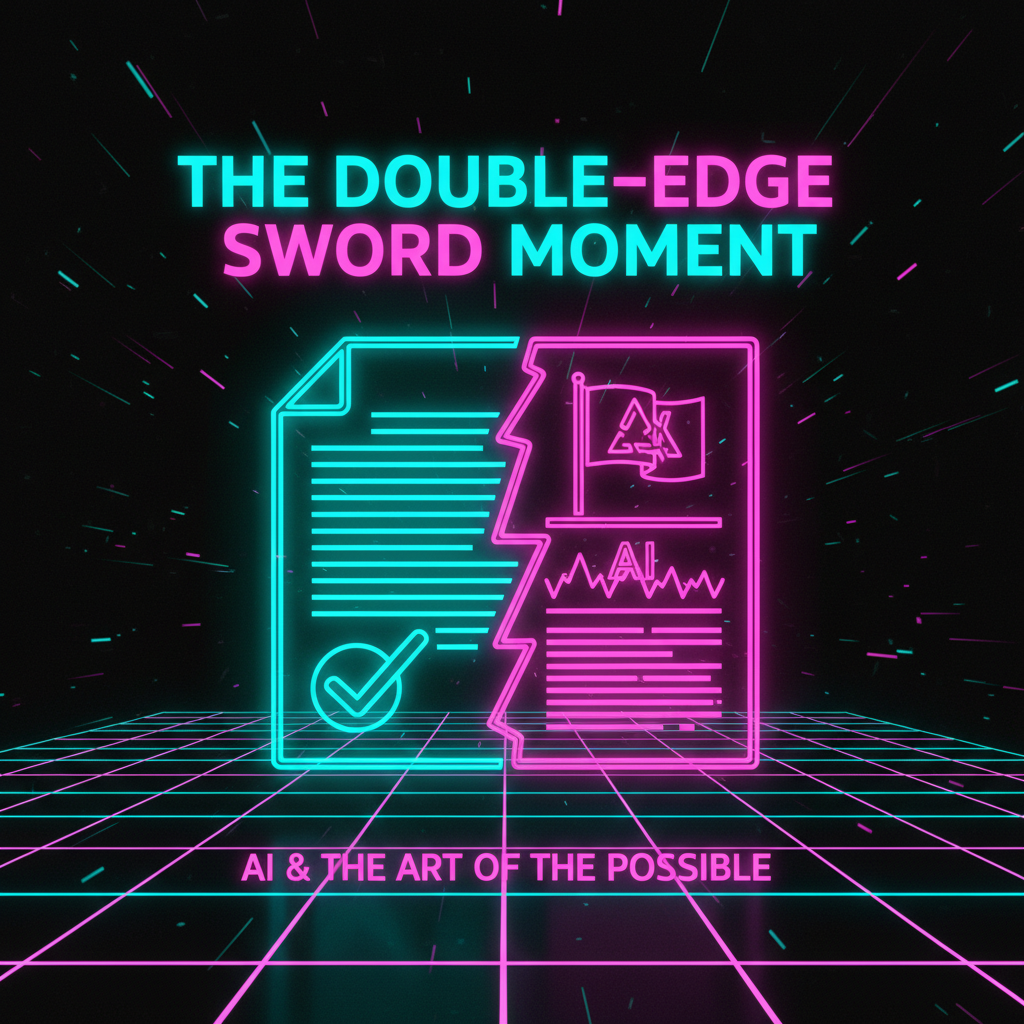
EP 04: The Double-Edged Sword Moment
I’m Chance Sasano, and this is The Art of the Possible, where I reveal which AI breakthroughs are changing everything, and which ones we’re getting wrong.
Here’s what’s actually happened. AI learned to write by studying millions of essays, good essays, clear thesis, supporting evidence, smooth transitions.
This kid learned to write the exact same way, same rules, same structure.
So when the kid writes well, the AI checker says, “Hey, that looks like me.”
And the crazy part is, the checker’s not wrong. It does look like AI, because AI learned to write from the best human writing, and this kid learned to write like the best humans. It’s a perfect circle of confusion. But here’s where it gets worse. Colleges use these same checkers. Four years of perfect grades potentially torpedoed because you write too well. The tool meant to catch cheaters is punishing the kids who followed every rule.
The solution?
Add mistakes to prove you’re human.
Excellence makes you suspicious.
Mediocrity makes you real?
And that’s the new normal.
Hello, Tuesday.
This isn’t just about essays.
Creating a deepfake used to take a Hollywood studio. Now? 30 seconds in a phone app.
Building a website used to take weeks of coding. Now? Describe it and watch it appear.
Writing code that would have taken me a week? Three minutes.
When powerful capabilities become effortless, everyone uses them. The good actors, the bad actors, your kid’s teacher, that scammer in another country.
Everyone. And we keep asking, “Who gets to decide how AI is used? Who’s in charge?”
These are the wrong questions. Nobody’s deciding. Everyone’s just using it. Think about what just happened to my friend’s kid. That teacher didn’t make some grand ethical decision about AI detection. They just clicked. Two seconds, done. The college admissions office will do the same thing. Not because they decided to. Because not doing it feels reckless somehow.
That’s what scares me. These tools are becoming so easy to use. Using them doesn’t even feel like a decision anymore. It’s like checking the weather, like Googling something, like breathing. Every powerful technology cuts both ways, but AI is different.
When Nobel invented dynamite, he knew both edges, construction and destruction.
When we split the atom, we knew power plants and bombs.
But with AI, we’re discovering new edges every day.
Monday, AI helps a struggling student finally understand calculus, changes their entire life trajectory.
Same Monday, AI falsely flags an honest student as a cheater.
Tuesday, someone with ALS speaks in their own voice again, thanks to AI.
Same Tuesday, a deepfake destroys someone else’s reputation.
Same tools, same day, building and destroying simultaneously.
And these aren’t edge cases anymore. They’re just cases.
My friend’s kid? Not unique. Happening in schools everywhere.
The deepfakes? Look at your social media feed. We’re all living on Tuesday now, where the miracle and the mistake use the same app.
So what do we do when everyone has the power and no one has control? I wish I had a clean answer. I really do, but I don’t.
But I know what doesn’t work. We can’t un-invent it. The genie multiplies. We can’t restrict it. It’s already on everyone’s phone. We can’t even detect it reliably. Just ask my friend’s kid.
Maybe the answer isn’t about control. Maybe it’s about resilience, building systems that assume both edges will cut, helping kids develop their unique voice, not just perfect form.
Creating multiple ways to verify the truth and accepting that Tuesday is here to stay.
My friend’s kid figured it out somehow, got into five schools, but they shouldn’t have had to figure it out. They shouldn’t have had to prove that they’re human to a machine.
That’s the Double-Edged Sword Moment
when excellence itself becomes suspicious.
Welcome to Tuesday.
I’m Chance, and this has been AI & the Art of the Possible. ew episodes every Tuesday. Find us wherever you get your podcasts, and don’t forget to subscribe.
Next episode, the simplest hack in cybersecurity history just breached 30 organizations. No code, no exploits, just a conversation with AI. The AI Hacker Moment with AI & the Art of the Possible.